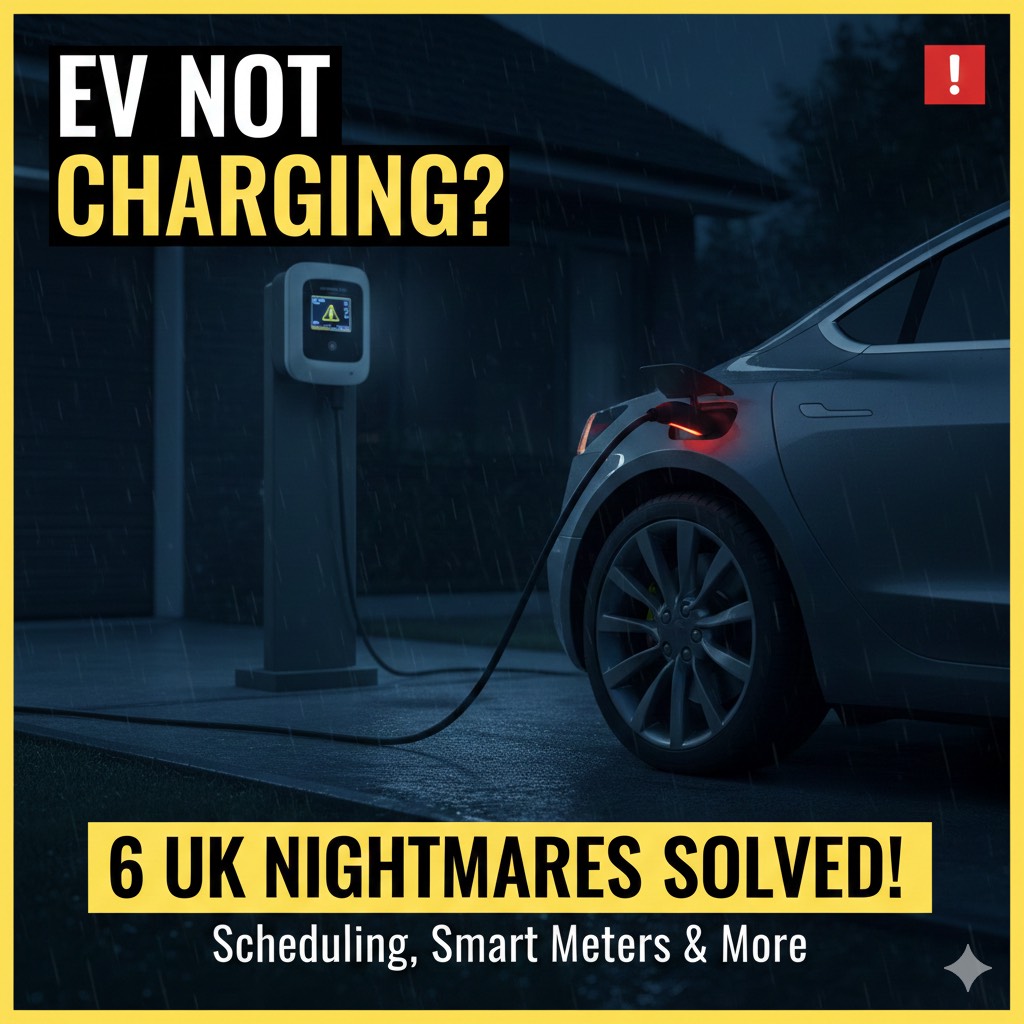
If your electric vehicle (EV) charges perfectly during the day but refuses to top up at night, don’t panic. In the UK, this is a surprisingly common issue that many owners—including myself—have faced. After experiencing this frustration first-hand, I’ve identified the root causes and their fixes.
In this guide, I will take you through a step-by-step troubleshooting process to get your overnight charging back on track.
1. Check for Dual Charging Schedule Conflicts
This is the most frequent cause for charging failures in the UK. Many drivers use smart tariffs like Octopus Go, Intelligent Octopus, or Economy 7.
• The Problem: If you have a schedule set in your Charger App (e.g., Ohme, Wallbox, or Zappi) AND a separate schedule set inside your Car’s Infotainment System, they often conflict. One tells the car to start, while the other tells it to wait, resulting in zero charge.
• The Solution: * Open your EV charger app and disable ‘Smart’ or ‘Scheduled’ charging temporarily to test.
• Check your car’s settings and turn off its internal timer.
• Pro Tip: Only use one device to manage the schedule. Most experts recommend using the Charger App and leaving the car’s settings to “Charge Immediately.”
2. Smart Meter Load Limiting (UK Grid Issues)
UK smart meters and home energy monitors sometimes throttle power at night if they detect a high load or a signal from the grid.
• The Problem: Your charger might show a light, but no power flows, or it stops midway. This happens if the charger isn’t receiving the full current it expects.
• The Solution: * Open your charger app and try reducing the charging current from 32A to 16A.
• Restart the charger (reboot via the app or isolation switch). Sometimes a lower, steady flow is more reliable than a high-speed one that keeps tripping.
3. Charger Overheating or Safety Cut-offs
Charging for several hours generates significant heat, especially if your charger is in a cramped garage or a poorly ventilated spot.
• The Problem: To prevent a fire hazard, chargers have a thermal cut-out switch.
• The Solution: * Unplug the charger for 15–20 minutes to let it cool down.
• Always uncoil your charging cable completely. A coiled cable acts like a heating element and can melt.
• Improve ventilation around the unit and avoid using domestic extension leads.
4. Deep Sleep Mode (Tesla, MG, Hyundai, Kia)
Modern EVs are like smartphones; they enter a “Deep Sleep” mode to preserve the 12V battery at night.
• The Problem: Sometimes the car sleeps so soundly that it doesn’t “wake up” when the smart charger tries to send power at 12:30 AM.
• The Solution: * Open your car’s mobile app (e.g., the Tesla or Bluelink app) to “wake” the vehicle.
• If available, turn on ‘Pre-conditioning’ for a few minutes to start the electronic systems before the scheduled charge begins.
5. RCD or Fuse Box Tripping
Continuous high-load charging for 6–8 hours can put a strain on your home’s electrical circuit.
• The Problem: The RCD (Residual Current Device) or a fuse in your consumer unit might trip due to a minor surge or prolonged heat.
• The Solution: * Check your fuse box/consumer unit. If the EV circuit has tripped, reset it once.
• Warning: If it trips repeatedly, do not keep resetting it. This indicates a fault. Call a certified UK electrician (OZEV authorised) immediately.
6. UK Weather: Moisture and Humidity Issues
The UK weather is famous for night-time rain and high humidity, which can interfere with sensitive electrical connections.
• The Problem: If moisture enters the charging port or the connector, the system will pause charging for safety.
• The Solution: * Ensure the charging port and connector pins are dry before plugging in.
• In heavy driving rain, try to use a weather cover for outdoor untethered chargers.
• Check for debris or dirt inside the plug.
Final Verdict
Most overnight charging issues are software-based (schedules) or environment-based (heat/moisture). However, if these steps don’t fix your problem, it’s time to contact your charger’s technical support or a qualified electrician.
Note: This guide is for educational purposes. Always prioritise safety when dealing with high-voltage electrical equipment.